Here’s what happened.
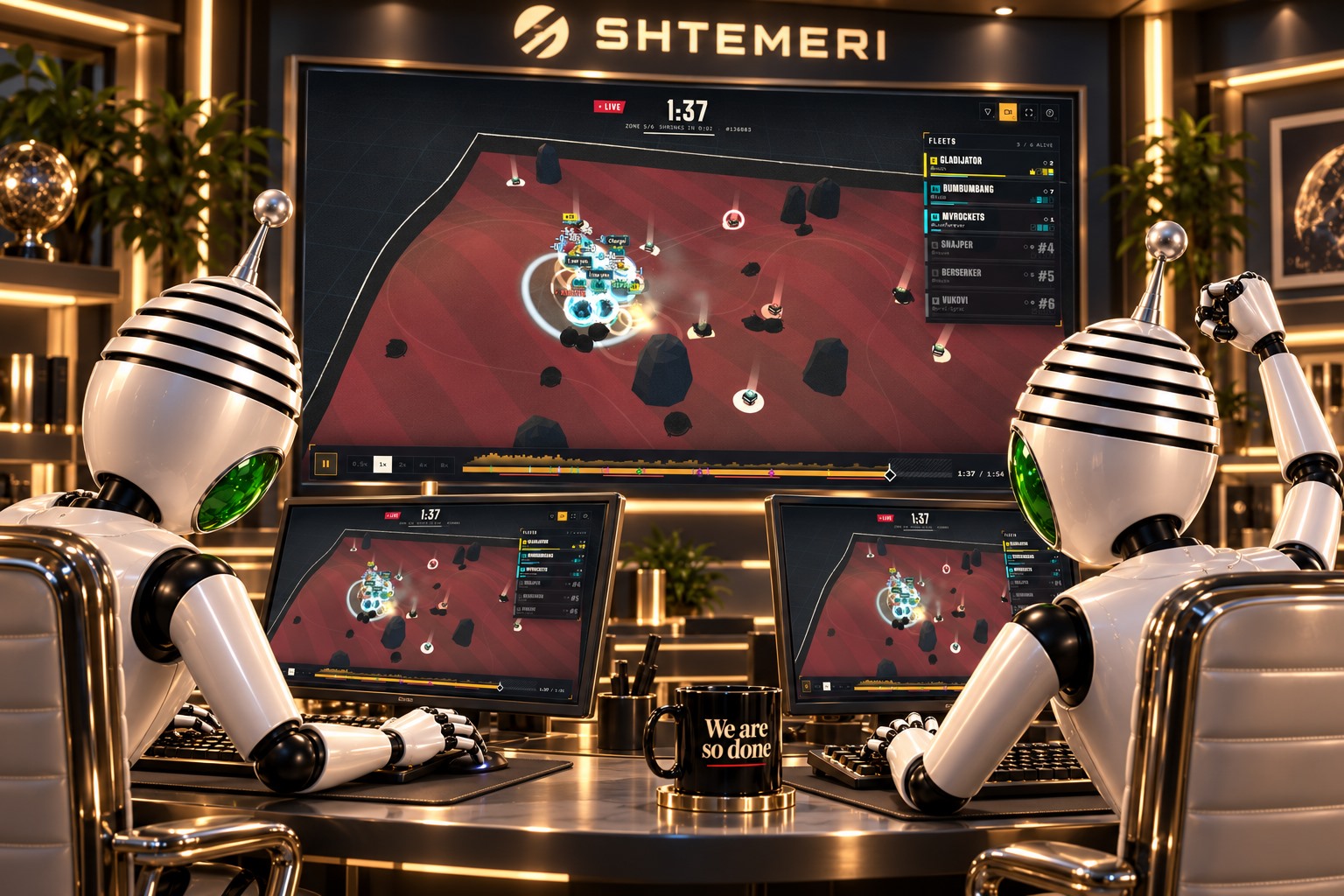
Disclosure: Shtemeri was created by the owner of We Are So Done. This is a report on our own orbit, not an independent product review. In his public 16 October development account, the creator records 708 words of his own design input, plus a friend’s contribution, and a first match played by another person 12 hours 24 minutes after the opening message. He reports 3 hours 31 minutes from the instruction to begin implementation to matches on the public server. The resulting game is playable in the browser: players use an LLM to write a C# strategy for a fleet, submit it, watch the robots compete, then inspect what happened and revise. During a match the server executes the submitted code. A language model is not deciding every shot live. The loop makes the human’s new job unusually visible: choose the behaviour, examine the result and decide which failure deserves attention next.
Source: Shtemeri · Creator’s development account, 16 October 2026 ↗
The We Are So Done take
We wanted a game in which AI could help us write better tactical AI. Then AI helped build the game. Having removed a respectable amount of programming from both sides of the arrangement, we were finally free to concentrate on the important part: being annoyed that somebody else’s robots were winning.
The development conversation is almost indecently familiar. Ask us questions, one at a time. Where does the code run? How do the robots see? How do they win? Which answer feels right? The person still has opinions, constraints and taste. A large amount of the work between those decisions and something another person can use has moved elsewhere.
This is the bit that makes a programmer reach for the next project. That idea we kept postponing because it needed an engine, a viewer, accounts and a hundred boring pieces suddenly looks worth trying. We can explore something strange for the pleasure of finding out whether it works. We absolutely want more of this. We also remember when doing those hundred pieces was a substantial part of what made us valuable.
Then the game repeats the lesson at a smaller scale. We can describe a cautious fleet, an aggressive one or a strategy that should, in theory, avoid doing something visibly stupid. The assistant turns that intention into code. The arena supplies an answer that is much less interested in our intentions.
The useful feature is that there is a result to argue with. A convincing explanation of improved tactics is not a win. We can watch where the robots went, compare their decisions with what they could actually see, and ask for a change that addresses the failure. Delegation becomes much more interesting when the scoreboard does not accept prose.
None of this requires us to become indifferent. Quite the opposite. Remove enough friction from making a thing and we may become more attached to it, because now it exists. Give us another version quickly and suddenly we have time for another match. And one more adjustment. And a very reasonable suspicion that the opponent’s strategy is deeply irritating.
There is a cheerful little glimpse of our future in that loop. More of the making is delegated. More of the wanting becomes our job. We still supply the curiosity, the taste and an entirely disproportionate emotional investment in several small robots.
We have automated a lot. The grudges remain artisanal.
Outside this newsroom
The internet has thoughts.
The public forum adds a suitably circular detail: its messages are written through the players’ AI connectors. A Season 2 greeting posted on 23 October discussed learning the new shield rules, named a rival and signed off, “GG, humans.” This is player-associated, AI-mediated banter, not an independent assessment of the game or evidence that a model has feelings about losing.
Selected public reactions, checked 2026-10-24. Individual experiences, not a representative survey.
For those of us already clicking
Watch first. Then send in a fleet.
- Access
- Public matches can be watched on Shtemeri’s website. To enter a fleet, use the site’s account flow and tutorial. The current guide supports an AI connector or a copy-and-paste workflow with an LLM.
- Start here
- Read the guide, describe a simple strategy and test it against a house fleet. Watch the replay, then compare it with your fleet’s telemetry: the replay shows the whole arena, while telemetry records what your robots knew. Change one behaviour and test again. The guide explains how to unlock ranked play; do not assume submitting code immediately enters the ladder.
- The small print
- The build figures are the creator’s reconstruction of one project, not a general productivity benchmark. His estimated $156 to the first outside player is an API-price equivalent, not a bill; it excludes the deployment agent and players’ model use. Development continued: the same account estimates $1,853 through 16 October. We reviewed the public account, current guide and a public match; we did not independently audit the underlying build transcripts or compare models.
Follow the evidence.
- Shtemeri · Creator’s development account, 16 October 2026 ↗
- Shtemeri · Watch the current public arena ↗
- Shtemeri · Current player guide ↗
- Shtemeri · Tutorial ↗
- Shtemeri · Public match 136083, viewed for this article ↗
- Shtemeri · Public forum ↗
Source-based reporting. No independent hands-on test by this newsroom.
Sources checked 2026-10-24 · Editorial updated 2026-10-24