Here’s what happened.
Dream Labs’ October release introduces Dream-1, an API for controlling robots with two arms and parallel grippers. The company demonstrates tasks such as placing fruit and hanging headphones on robots absent from the relevant model’s training. This is transfer within a constrained family of machines, not a universal brain for any body. The published rate is $3 per hour for Dream-1 inference; hardware and operation cost extra. The model remains a research beta. Its performance depends partly on the robot’s own motion solver, and difficult geometry or obstacles can defeat the requested movement.
Source: Dream Labs · Dream-1 research release, October 2026 ↗
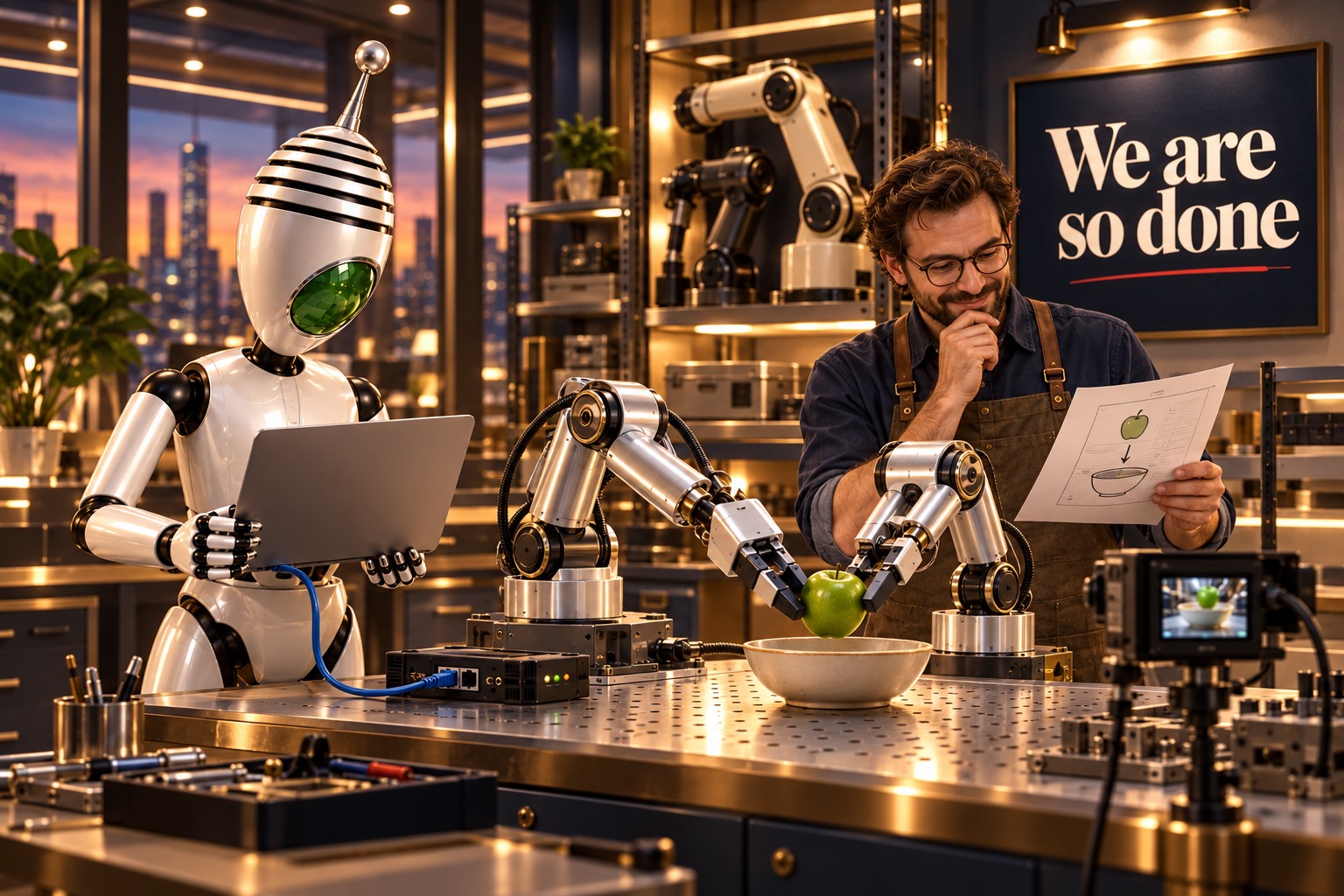
The We Are So Done take
We had a comforting sentence ready. Fine, the computer can write the email, make the image and build the software. Somebody still has to pick the thing up and put it somewhere else. We said this with the confidence of people who had not personally enjoyed picking the thing up.
So naturally we want the robot. We want the counter cleared, the repetitive job finished and the afternoon returned to us. A machine that can acquire a useful skill without an entire new engineering project is exactly the sort of progress we would like delivered quickly.
The slightly less restful thought is what happens when the skill travels. If the knowledge of how to do something becomes available through a connection, a new pair of arms might start with more than an instruction manual. We have become accustomed to downloading an application. Downloading a reason to need fewer hands will take a little longer to feel ordinary.
We should keep watching the actual attempt. An impressive movement is a start. A completed task is better. Doing it again, around the things we forgot to tidy away, is where the promise has to earn its place. The floor does not accept a persuasive explanation of why the bowl should still be intact.
That gap does not make the direction boring. It gives us a very concrete way to follow it. Fewer failed grasps. Less teaching for the next machine. A longer stretch of useful work before somebody intervenes. Each improvement will arrive with an entirely reasonable reason to welcome it.
We will probably be standing there with a parcel, delighted that the hardware has arrived. Our own hands will remain essential for opening the box.
For now.
Outside this newsroom
The internet has thoughts.
The Hacker News discussion contains both the wish list and the objection. Some participants welcome the prospect of help with meals, cleaning and laundry. Others question whether short demonstrations are a useful starting point for dependable industrial work. One commenter describing automation experience says the demos are appealing to explore but difficult to connect to the manufacturing and warehouse work they know. These are attributed reactions, not a representative survey or our own test.
Selected public reactions, checked 2026-10-25. Individual experiences, not a representative survey.
For those of us already clicking
Start with the simulation, then count interventions.
- Access
- Dream Labs has a public playground with simulation and a separate real-robot mode. Running the API on your own hardware requires a compatible robot and setup.
- Start here
- Choose simulation and one simple pick-and-place task. Record what actually moves, whether the task finishes and how often you retry. Repeat it before increasing the difficulty. A simulation result does not establish reliability on physical hardware.
- The small print
- We reviewed documentation and attributed public discussion; we did not operate a robot. Dream Labs explicitly labels the model a research beta and says it has not been validated for safety-critical use.
Follow the evidence.
- Dream Labs · Dream-1 research release, October 2026 ↗
- Dream Labs · Public robot and simulation playground ↗
- Dream Labs · API setup entry point ↗
Source-based reporting. No independent hands-on test by this newsroom.
Sources checked 2026-10-25 · Editorial updated 2026-10-25